Finding Your Zone: How Youngsters Can Decide Careers with Passion & Potential
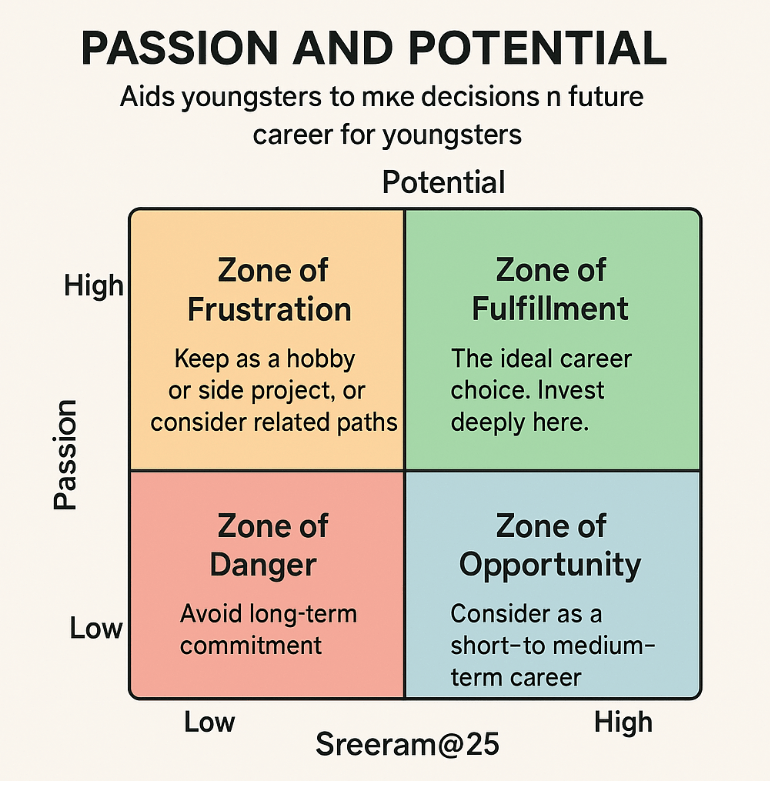
The Matrix
| High Potential | Low Potential | |
|---|---|---|
| High Passion | Zone of Fulfillment | Zone of Frustration |
| Low Passion | Zone of Opportunity | Zone of Danger |
Quadrant Explanations
1. High Passion + High Potential → Zone of Fulfillment
- This is the ideal career choice.
- You love what you do, and you’re naturally skilled or have the ability to excel with effort.
- Example: A student who loves coding and shows great problem-solving skills moving into computer science or AI.
- Decision: Invest deeply here. Build expertise, network, and gain experience.
2. High Passion + Low Potential → Zone of Frustration
- You enjoy doing it but may not have the natural strengths or opportunities to excel.
- Example: Someone passionate about professional sports but doesn’t have the physical ability to compete at the highest level.
- Decision: Keep as a hobby or side project, or develop realistic alternate career paths where passion still helps (sports management, coaching, analytics).
3. Low Passion + High Potential → Zone of Opportunity
- You’re good at it, but your heart isn’t in it.
- Example: A student who is excellent in mathematics but doesn’t enjoy working with numbers daily.
- Decision: Consider if this can be a short- to medium-term career for stability while you explore passion areas. Sometimes passion can grow with mastery and rewards.
4. Low Passion + Low Potential → Zone of Danger
- Neither interest nor ability exists strongly.
- Example: Someone weak in and disinterested in accounting but forced to pursue it due to external pressure.
- Decision: Avoid long-term commitment. Redirect your energy into areas where at least one (passion or potential) is higher.
Key Takeaway for Youngsters
- Best path: High Passion + High Potential.
- Realistic path: Sometimes you start in the Opportunity zone (high potential, low passion) and slowly build interest.
- Healthy balance: Keep your Frustration zone passions alive as hobbies; they give joy and balance.
- Avoid Danger zone careers, as they often lead to burnout, stress, and dissatisfaction.
Steps to Find Your Passion
1. Reflect on What Energizes You
- Ask yourself: What activities make me lose track of time?
- Tool: Journaling – keep a daily/weekly note of activities that make you happy and excited.
2. Notice What You’re Curious About
- Pay attention to books, videos, or topics you naturally explore.
- Tool: Curiosity Map – write down topics you research or follow without being forced.
3. Experiment with Interests
- Try internships, volunteering, clubs, or short projects.
- Tool: Passion Tracker – a simple spreadsheet rating each activity (Fun Level 1–10, Would I do this for free?).
4. Ask for Outside Feedback
- Sometimes others see your spark better than you.
- Tool: 360° Feedback – ask friends, teachers, or mentors: “When do you see me at my best?”
Steps to Identify Your Potential
1. Evaluate Your Skills
- Note down things you’re naturally good at (academic, creative, or practical).
- Tool: Strengths Finder – list 5 top skills, validated by school performance or projects.
2. Assess Your Aptitude
- Try aptitude tests or online career assessments.
- Tool: Free career tests like 16Personalities, Holland Code (RIASEC), or Career Explorer.
3. Match Skills with Demand
- Research industries where your skills are valued.
- Tool: SWOT Analysis (Strengths, Weaknesses, Opportunities, Threats) for your skills.
4. Test Through Real-World Practice
- Internships, part-time work, or competitions help measure actual potential.
- Tool: Portfolio – collect projects, certificates, and achievements to see patterns.
Combine Passion and Potential
- Place your findings into the 2×2 Passion & Potential Matrix:
- High Passion + High Potential → Career Path
- High Passion + Low Potential → Hobby/Side Project
- Low Passion + High Potential → Opportunity/Short-Term Career
- Low Passion + Low Potential → Avoid
✅ Key Takeaway:
- Passion shows what excites you.
- Potential shows where you can succeed.
- Your future career sweet spot lies where the two overlap.


Leave a Reply